 Nic Dunn, CEO, Charle Agency
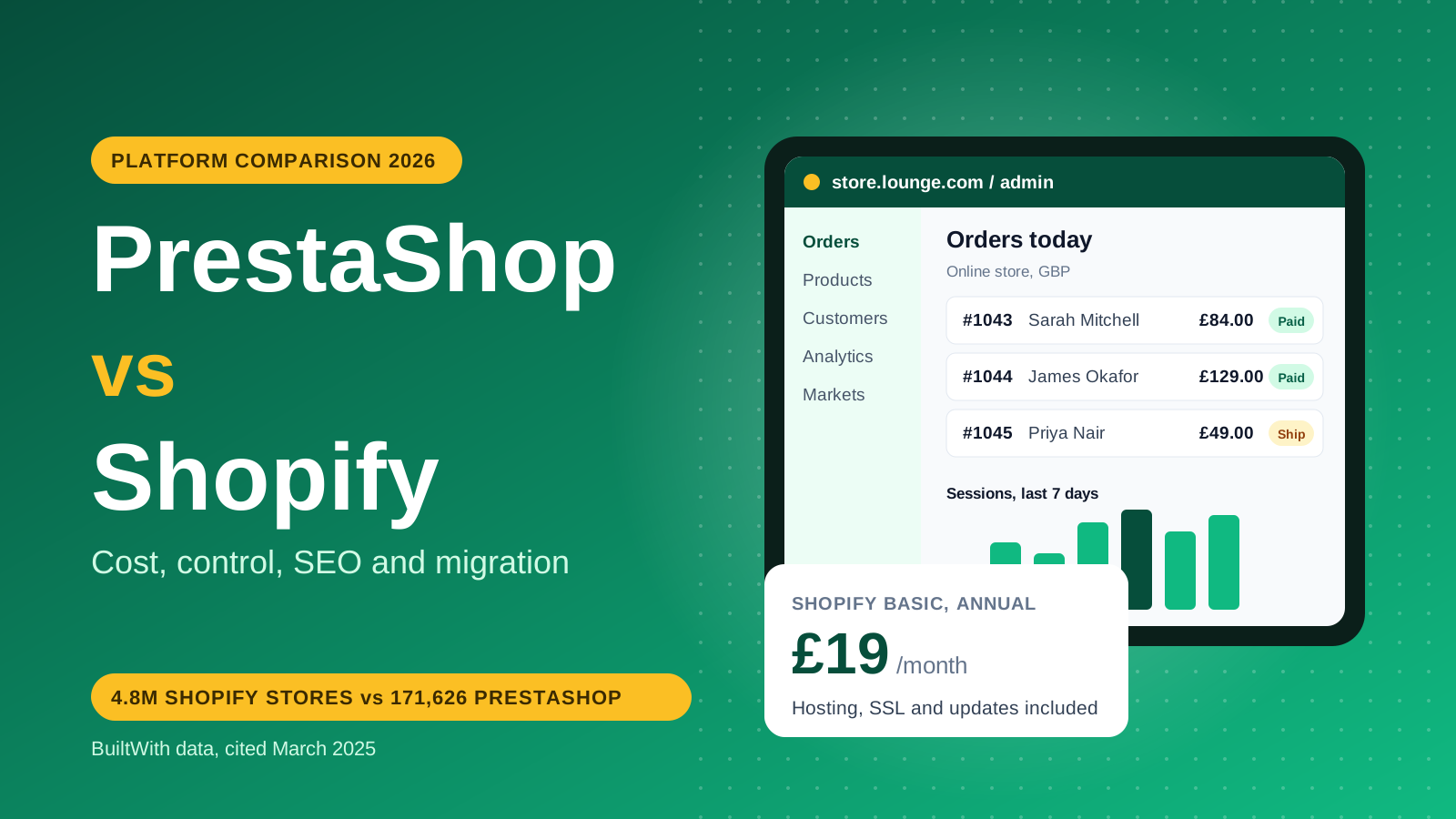
PrestaShop vs Shopify at a Glance
Shopify suits most UK brands that want to sell, not run servers. PrestaShop suits teams with in-house developers who need to change the core code or run many stores from one back office.
Here is the short version:
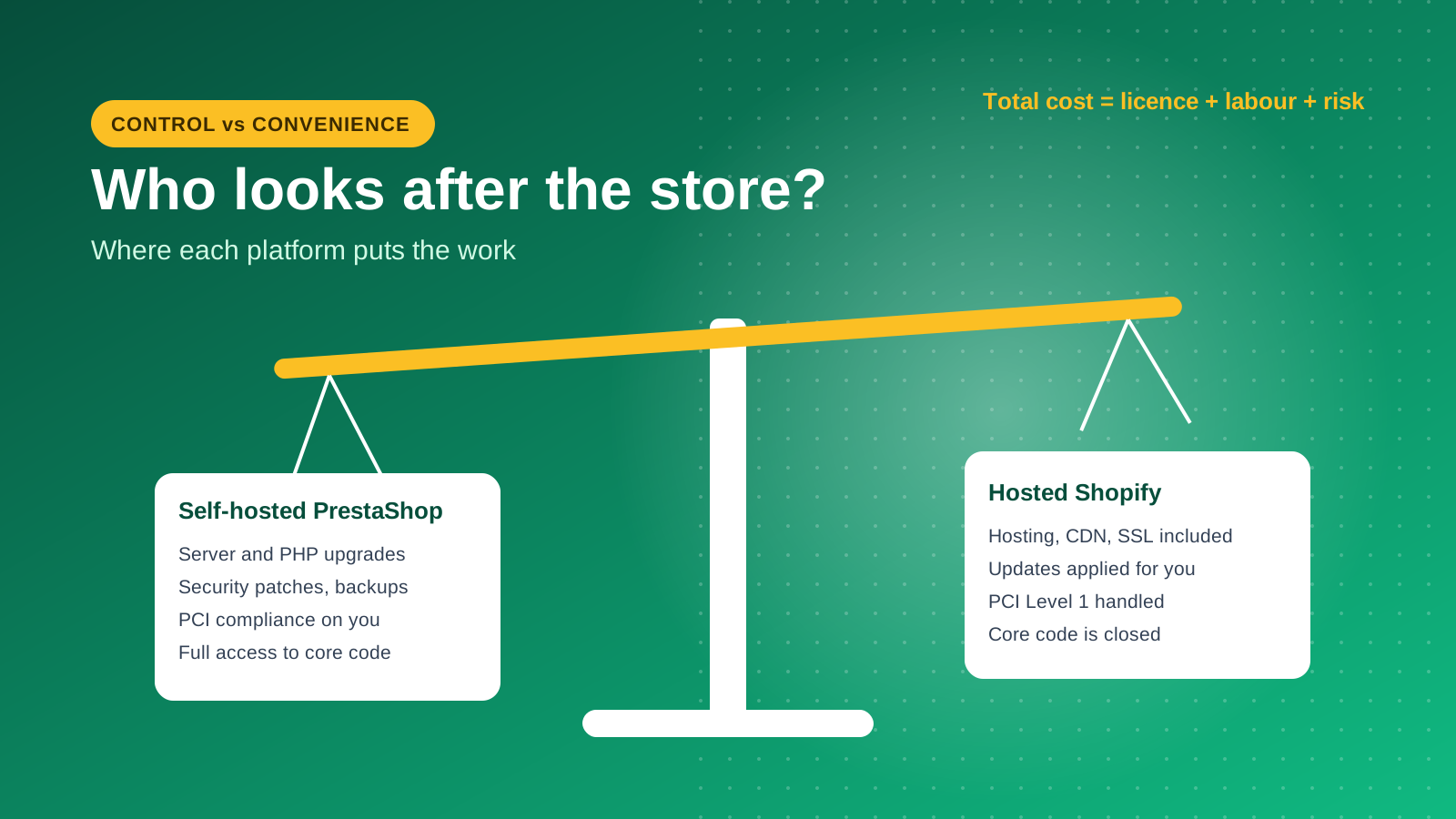
- Hosting: PrestaShop is self-hosted. Shopify hosting, CDN and SSL are included.
- Licence: PrestaShop is free to download. Shopify starts at £5 per month on Starter and £19 per month on Basic with annual billing.
- Code access: PrestaShop gives you the full source. Shopify keeps the core closed and extends through themes, apps and APIs.
- Upkeep: PrestaShop upgrades, patches and backups are your responsibility. Shopify applies them for you.
- Best for: PrestaShop suits developer-led teams. Shopify suits growth-led teams.
Budget, team skills and growth plans decide which of the two ecommerce platforms is right for your business. PrestaShop works like an open-source CMS that you install and run yourself, while Shopify is a hosted platform with the hosting, tools and updates built in. Neither platform is wrong in every situation, and the rest of this guide shows where each one earns its place.
What Is PrestaShop?
PrestaShop is an open-source ecommerce platform founded in Paris in 2007. You download the software, install it on a server you choose, and own the code, the database and the infrastructure. It is popular in France, Spain and Italy, and it has native multistore, multilingual and multi-currency features.
The freedom is real. A developer can change checkout logic, database structure or product rules without asking anyone's permission. The trade-off is that every part of running the store becomes your job: hosting, PHP versions, security patches, backups and PCI compliance. PrestaShop 9 sets PHP 8.1 as its minimum version, so stores still running older releases need planned upgrade work.
What Is Shopify?
Shopify is a hosted ecommerce platform. You pay a monthly plan and Shopify runs the infrastructure: servers, CDN, SSL, checkout, updates and PCI Level 1 compliance. You customise through themes, apps and the Shopify APIs rather than editing the core.
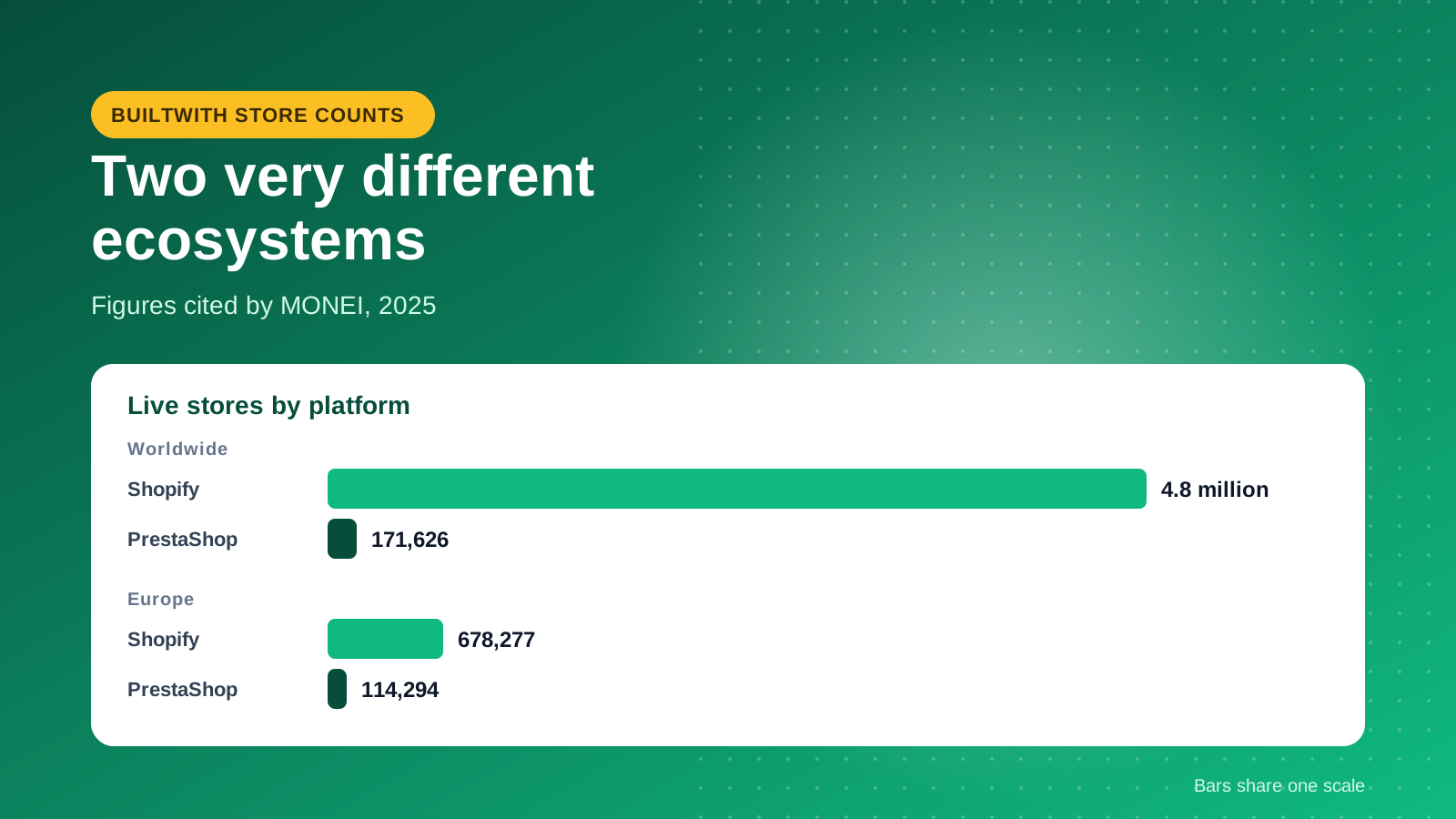
That model removes a lot of operational risk. It is also why Shopify now powers over 4 million online stores worldwide. BuiltWith data cited by MONEI in 2025 put Shopify at 4.8 million stores against 171,626 for PrestaShop, and 678,277 against 114,294 across Europe. Shopify Plus extends the platform for high-volume brands with checkout customisation, automation and B2B features; our guide to Shopify vs Shopify Plus explains when to upgrade.
PrestaShop vs Shopify Cost: What You Really Pay in the UK
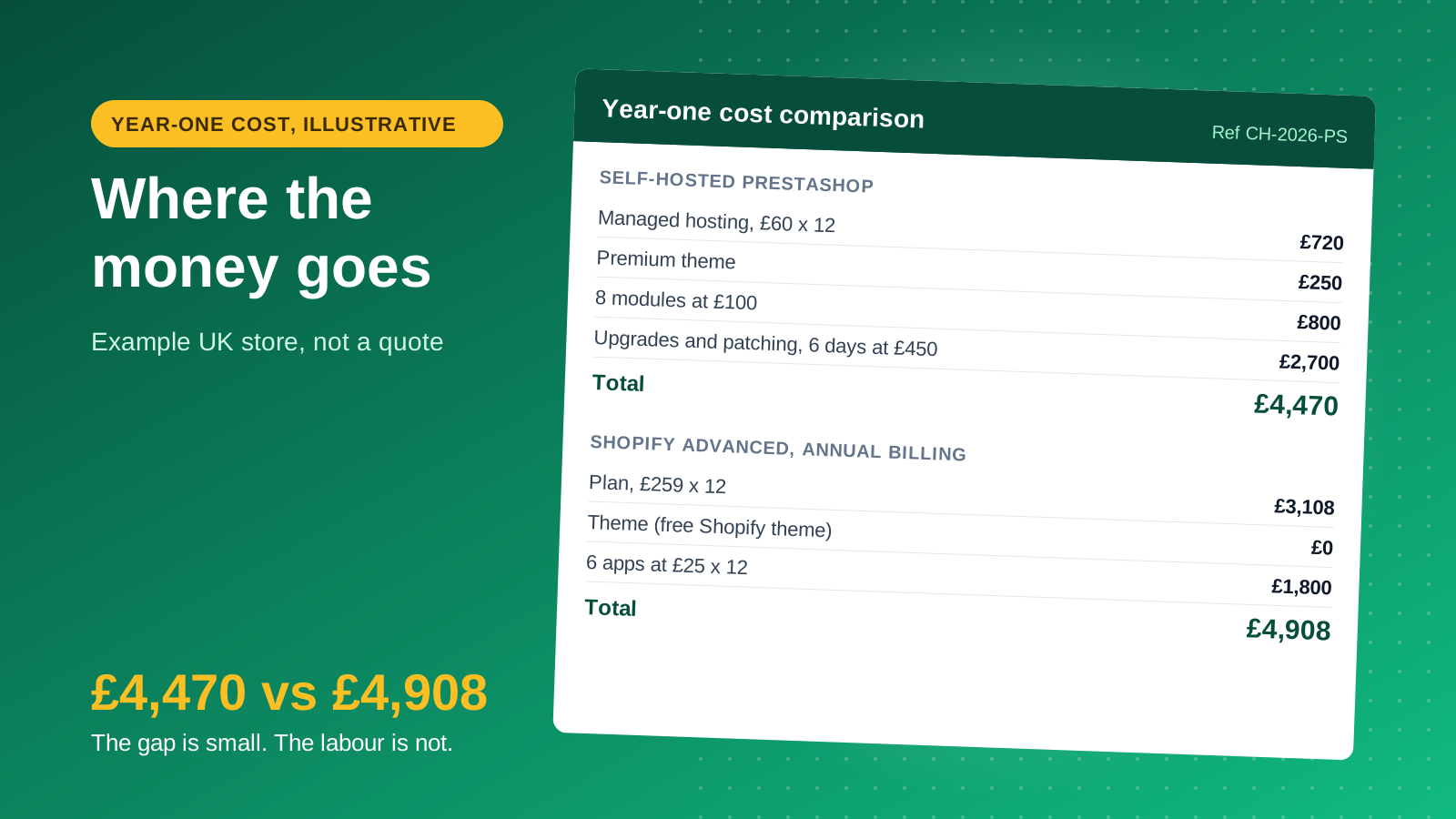
PrestaShop is free to download, which is why it looks cheaper. The licence is rarely the real cost. A live PrestaShop store needs hosting, a theme, paid modules for many features, and developer time for upgrades and security. Module prices commonly run from tens to a few hundred pounds each.
Shopify charges for the plan instead. UK pricing is Starter at £5 per month, Basic at £19 per month billed annually (£25 monthly), Grow at £49 (£65 monthly), Advanced at £259 (£344 monthly) and Plus from £1,800 per month on a three-year term. Shopify Payments removes the platform transaction fee; using a third-party gateway adds one. Our full breakdown of Shopify pricing covers fees, apps and break-even points.
The illustration below compares year-one costs for an example mid-size UK store. These are illustrative figures, not a quote, but they show where the money moves. PrestaShop spends less on licences and more on labour. Shopify spends more on subscription and apps and less on upkeep. The right answer depends on whether your developers' time is better spent patching servers or improving conversion.
Payment costs differ too. Shopify adds a transaction fee when you use third-party payment gateways instead of Shopify Payments. PrestaShop does not charge platform transaction fees, but its payment gateway modules and providers such as PayPal or Stripe bill their own processing rates. Set a realistic budget for year one and for ongoing upkeep, then compare the options on total cost rather than licence price.
Ease of Use and Day-to-Day Management
Shopify is easier to run. Merchandisers can add products, build collections, edit pages and manage discounts without a developer. Staff accounts scale with the plan: Grow includes up to 5 and Advanced up to 15.
PrestaShop's back office is capable, but it asks more of the people using it. Setup, module configuration and updates usually need technical help, and the quality of each module varies. If the team running the store is mostly marketers and operations staff, that friction shows up as slower launches.
Shopify's admin interface is designed for non-technical users, with a dashboard for orders, products, customers and sales reports. PrestaShop installation, module setup and template changes usually call for a developer, which adds time before new users can work independently.
PrestaShop does have one clear advantage here: multistore management from a single back office is built in. Shopify handles multiple markets through Shopify Markets and separate stores on Plus, which is simpler for most brands but different in structure.
Customisation and Flexibility
PrestaShop wins on raw customisation. You can modify core files, change how the checkout works and build deeply bespoke product logic. For genuinely unusual commercial rules, that freedom matters.
Shopify wins on safe customisation. Themes control the front end, apps add features, and the Shopify APIs and Functions let developers extend discounts, delivery and checkout behaviour without touching the platform itself. Because the core stays untouched, upgrades do not break your customisations. Most brands never need to change a core they cannot see, and they gain reliability in return.
Before you commit to PrestaShop for flexibility, list the features you actually need. If every item can be built with a Shopify theme, an app or a custom function, you are paying for freedom you will not use.
Performance, Hosting and Security
With Shopify, performance and uptime are Shopify's problem. The platform includes a global CDN, scales through traffic spikes such as Black Friday, and handles PCI Level 1 compliance and security patching automatically.
With PrestaShop, performance depends on your host, your PHP version, your caching and the modules you install. A well-tuned stack can be quick, but you must build and monitor it. Security is also on you: out-of-date modules are a common route for attacks on self-hosted stores, and a missed patch is a business risk rather than a minor chore.
Page speed affects both rankings and conversion, so the hosting model is a commercial decision as much as a technical one.
SEO and Selling Across Europe
Both platforms can rank well. Shopify gives you editable titles, meta descriptions, canonical tags, sitemaps and structured data out of the box, and our Shopify SEO guide covers the details. Shopify has some fixed URL patterns, such as /products/ and /collections/, which are manageable with good information architecture.
PrestaShop gives you more control over URL structure and technical SEO, but you are responsible for the speed, caching and schema that Shopify handles by default.
For international selling, PrestaShop has long been strong in multilingual European stores. Shopify has narrowed that gap with Shopify Markets, which supports multiple currencies, languages, local domains and duties estimates on higher plans. Many UK brands selling into the EU now manage it from one Shopify store.
Apps, Modules and Ecosystem
PrestaShop offers roughly 4,000 modules and thousands of themes through its Addons marketplace, and a large European developer community. Shopify's app store is larger, with thousands of apps, and its partner ecosystem of agencies, themes and integrations is far bigger.
The practical difference is maintenance. A Shopify app is hosted by its vendor and updated for you. A PrestaShop module runs inside your store, so you must keep it compatible with your PrestaShop version, your PHP version and every other module. Ecosystem size matters less than how much of it you have to babysit.
If you are also weighing WooCommerce, the same trade-off applies. A WordPress plugin gives flexibility and plenty of templates, but hosting, security and plugin maintenance sit with you. The tools and apps you choose should depend on the support you can rely on after launch, not just the feature list.
Migrating From PrestaShop to Shopify Without Losing Rankings
Moving platforms is where organic traffic is won or lost. The platform switch itself is rarely the risk. The risk is changing URLs, dropping metadata and launching without redirects.
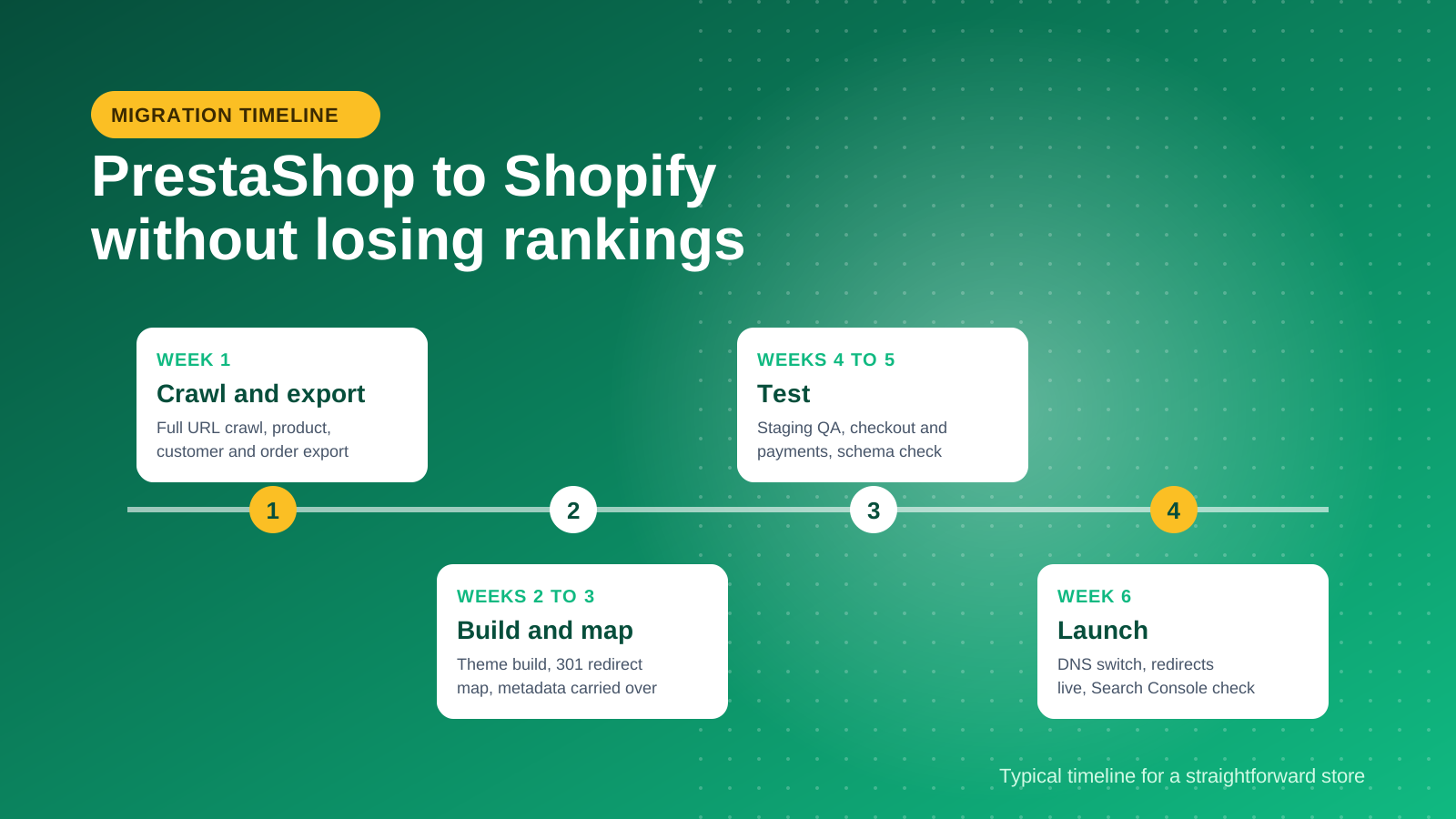
A safe migration follows a clear order:
- Crawl first: record every live URL, title, meta description, heading and canonical before you touch anything.
- Export your data: products, variants, customers, orders and reviews, cleaned before import.
- Map redirects: build a 301 redirect for every old URL that will change, starting with your top pages by traffic and revenue.
- Carry over SEO: keep titles, descriptions, alt text, structured data and internal links.
- Test on staging: check checkout, payments, shipping rules, tracking and schema before launch.
- Monitor after launch: watch Search Console for crawl errors, index coverage and ranking shifts for at least eight weeks.
A straightforward store can move in four to six weeks. Complex builds with custom modules, several markets or large catalogues take longer. Our migrate to Shopify guide and ecommerce replatforming guide cover the planning in more depth.
Which Should You Choose?
Choose Shopify if you want to grow revenue rather than manage infrastructure, your team is mostly commercial, you sell direct to consumers or through multiple channels, and you want predictable costs and fast launches.
Choose PrestaShop if you have in-house developers, need to modify core behaviour, want a self-hosted open-source stack, or run many stores with deeply shared catalogue logic.
Many businesses assume the choice is about features, but most sales are lost to slow pages and clumsy checkouts rather than missing options. For most UK brands we speak to, the deciding factor is not features. It is who carries the operational burden and risk. If your PrestaShop store is already costing more in patching and rescue work than it returns in flexibility, it is time to look at moving. Comparing a wider set of platforms? Our Shopify vs Magento comparison covers another common replatforming route.
If you want an honest view on whether to stay or move, our Shopify Plus agency team can audit your current store, and you can get in touch to talk it through.