 Nic Dunn, CEO, Charle Agency
Shopify Pricing Overview for 2026
Shopify offers five main pricing tiers in the UK, ranging from £5 per month for social selling to custom enterprise pricing for high-volume merchants. Whether you are launching your first store or scaling a multi-million pound operation, understanding exactly how Shopify works and what each plan includes is the foundation for making a sensible commercial decision.
All Shopify plans include secure hosting, SSL certificates, unlimited bandwidth and 24/7 support. You never pay separately for hosting or security. This is a significant advantage over alternatives like Magento or WooCommerce, where those costs accumulate quickly and require ongoing technical management.
Here is a quick overview of current Shopify pricing in the UK:
- Starter: £5 per month
- Basic: £19 per month (billed annually) or £25 monthly
- Grow: £49 per month (billed annually) or £65 monthly
- Advanced: £259 per month (billed annually) or £344 monthly
- Plus: From £1,800 per month (3-year term)
Shopify currently offers new merchants their first three months for just £1 per month on Basic, Grow and Advanced plans, plus a 3-day free trial before committing. Annual billing saves 25% across all plans except Starter, which is monthly only.
One thing worth knowing upfront: the subscription fee is rarely your largest ongoing cost. For most merchants processing meaningful sales volume, transaction fees and app costs exceed the plan fee itself. The sections below break all of this down.
Shopify Plans Compared: Features at Each Tier
The differences between plans go well beyond the monthly fee. Staff access, reporting depth, shipping capabilities and payment processing rates all shift significantly as you move up. Choosing the wrong tier costs you either through overpaying for features you do not use, or through higher transaction fees that erode your margin at scale.
Every paid Shopify plan includes unlimited products, collections and file storage. Abandoned cart recovery, discount codes, gift cards and access to the Shopify App Store are available across all tiers. The meaningful differences lie in four areas.
Staff accounts scale with each tier. Basic covers the store owner only, Grow adds up to 5 staff accounts, Advanced increases this to 15, and Plus offers unlimited staff with granular role-based permissions. For growing teams this matters early. You need your operations, customer service and marketing people in the admin without sharing a single login.
Inventory locations are generous on all standard plans, with Basic through Advanced supporting up to 10 locations. Shopify Plus extends this to 200 locations for multi-warehouse or franchise operations.
Reporting steps up at each tier. Basic provides fundamental analytics. Grow adds professional reports across sales, customers and marketing. Advanced opens up custom report building. Plus delivers enterprise-grade business intelligence and cohort analysis. Across the Shopify Plus accounts we run, merchants consistently undervalue this until they are trying to optimise and cannot get the data they need.
International selling capabilities improve with each tier. All plans include Shopify Markets for basic multi-currency and multilingual selling. Advanced and Plus add custom pricing per market, local domains and estimated duties at checkout.
For a broader view of why businesses choose this platform, see our guide on why you should choose Shopify.
Transaction and Payment Processing Fees
Beyond the monthly subscription, transaction fees are often the largest ongoing cost for Shopify merchants, and the area where plan choice has the greatest financial impact. These fees compound with every sale, so getting this right matters more than most people realise when they are choosing a plan.
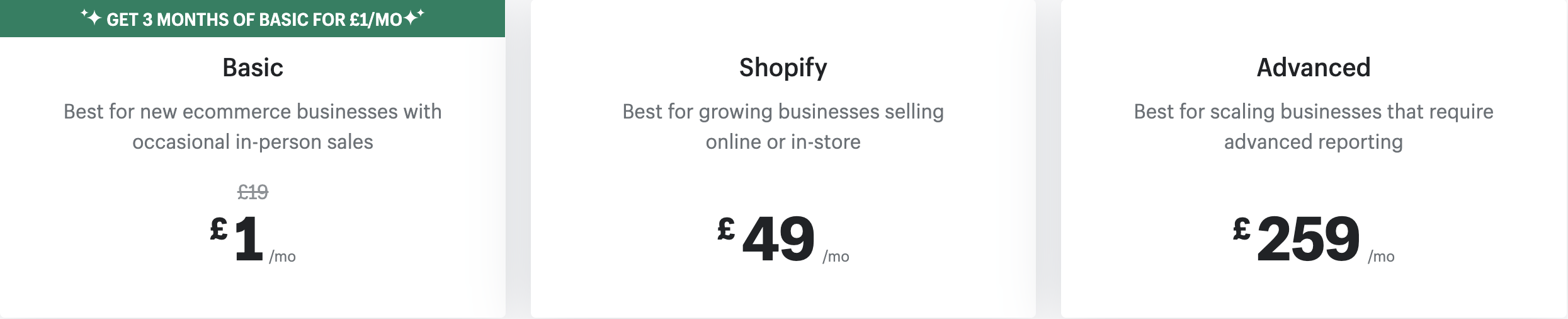
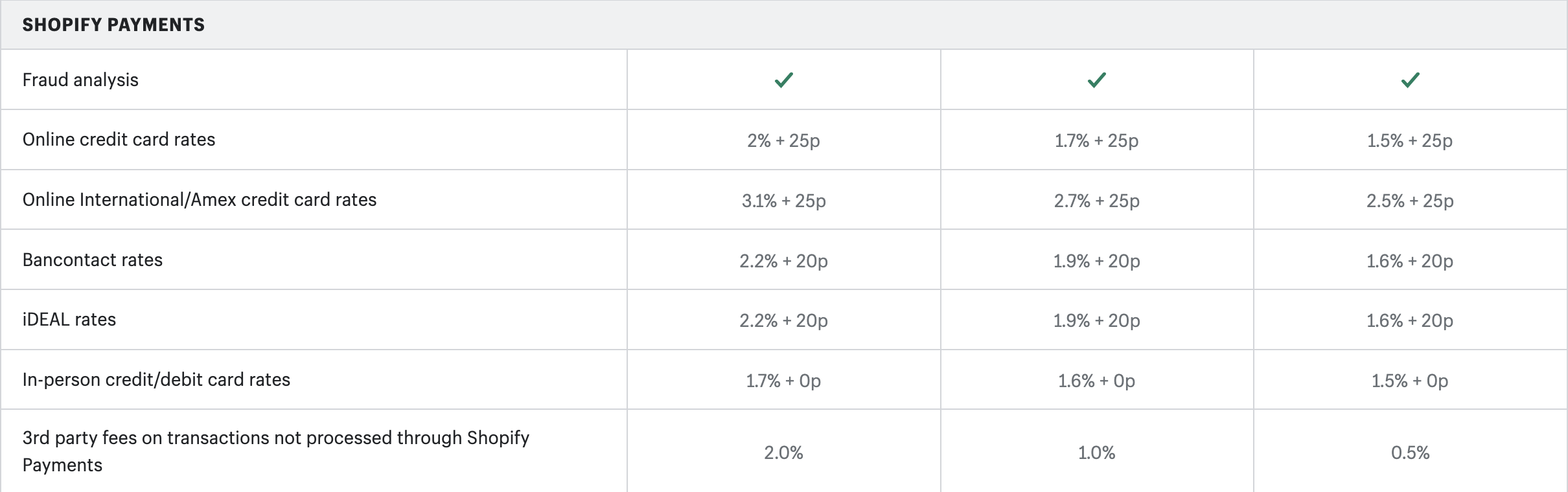
Shopify Payments is Shopify's built-in payment processor, powered by Stripe. It accepts Visa, Mastercard, American Express and all major digital wallets, plus the wider set of payment methods customers expect at checkout. Using Shopify Payments eliminates third-party transaction fees entirely, leaving you only with the credit card processing rate. Current UK online credit card rates are:
- Basic: 2.0% + 25p per transaction
- Grow: 1.7% + 25p per transaction
- Advanced: 1.5% + 25p per transaction
- Plus: From 1.3% + 25p (negotiated lower at high volume)
In-person card rates through Shopify POS are lower:
- Basic: 1.7% per transaction
- Grow: 1.6% per transaction
- Advanced: 1.5% per transaction
Third-party payment gateway fees apply on top of the provider's own charges if you use PayPal, Worldpay or another external processor instead of Shopify Payments:
- Basic: 2.0% additional fee
- Grow: 1.0% additional fee
- Advanced: 0.6% additional fee
For most UK merchants, Shopify Payments is the right choice. It removes the third-party fee layer, settles faster and integrates natively with your analytics. The main reason to use an alternative is if your product category is restricted by Shopify Payments or if you operate in a region where it is not supported.
What Shopify Actually Takes from a £100 Sale
The pricing page numbers can read abstractly until you anchor them to a concrete order. As an example, here is what each tier costs you on a single £100 online transaction paid by credit card through Shopify Payments. No third-party gateway, no extras, just the headline fee structure that lands on the order.
- Starter: £5 transaction fee (5% on Shopify Payments) plus card processing = approximately £7.25 per £100 sale
- Basic: £2.00 + 25p card rate = £2.25 per £100 sale (no transaction fee on Shopify Payments)
- Grow: £1.70 + 25p = £1.95 per £100 sale
- Advanced: £1.50 + 25p = £1.75 per £100 sale
- Plus: From £1.30 + 25p = £1.55 per £100 sale at the published rate (typically negotiated lower at high volume)
The headline difference between Basic and Advanced is 50p per £100 in card processing fees. Small in isolation, meaningful at volume. A store processing £100,000 monthly online pays roughly £1,750 in card fees on Advanced versus £2,250 on Basic. That £500 monthly delta covers the plan difference twice over, before you add in the value of custom reporting, third-party calculated shipping rates and 15 staff accounts. The structure of Shopify's tiers is deliberately built so that the next tier pays for itself once you cross a clear revenue threshold.
The maths flips for low-volume sellers. For example, a store at £3,000 monthly revenue pays £67.50 in credit card fees on Basic and £52.50 on Advanced, a £15 saving against a £225 plan-cost difference. Until your transactions move meaningful sales volume, the higher plan loses money. The break-even analysis later in this article walks through the exact thresholds for each upgrade or downgrade.

Shopify Starter: £5 per Month
The Shopify Starter plan is for creators, influencers and side-hustle sellers who want to monetise an existing audience through social channels or an existing website, without building a full online store. At £5 per month it is the most affordable entry point to Shopify's commerce infrastructure.
Starter does not include a standalone online store. Instead, you get Linkpop (Shopify's link-in-bio tool), buy buttons you can embed on any website, and the ability to sell through WhatsApp, Instagram DMs and other messaging platforms. The Shopify admin handles your product catalogue and inventory; customers complete checkout through Shopify's hosted checkout. This setup suits sellers with a small catalogue and an established audience who need a checkout, not a full website.
Transaction fees are higher at 5% when using Shopify Payments, reflecting the lower subscription. For any merchant doing consistent volume, these fees make Starter uneconomical quickly. A store processing £3,000 per month pays £150 in transaction fees on Starter, more than six times the subscription cost.
Starter is right for: social media sellers and influencers, bloggers adding a shop to an existing WordPress site, and merchants testing product-market fit before committing to a full store.
If you need a proper ecommerce website, Basic is the starting point, not Starter.

Shopify Basic: £19 to £25 per Month
Basic is the entry tier for merchants who want a complete, professional online store. At £19 per month annually (or £25 month-to-month), it includes everything most new businesses need to launch and start selling.
You get a fully hosted ecommerce website with your own domain, unlimited products in unlimited collections, discount codes, gift cards, abandoned cart recovery and 24/7 support. The store editor, Online Store 2.0, lets you customise layouts, create new page templates and adjust your theme without touching code.
Basic includes access to Shopify Markets for international selling with localised currencies, languages and domains. Up to 10 inventory locations are supported, which covers most small-to-medium operations. Shopify POS Lite is included for in-person selling; the full POS Pro feature set adds £69 per month per location.
The main limitations of Basic are the absence of additional staff accounts (the owner only has access), basic-level reporting only, and the highest transaction fees in the standard range. For many new businesses these are entirely acceptable trade-offs. As we tell clients starting out: launch on Basic, validate your model, then upgrade when the transaction fee savings justify it. This typically happens around £10,000-£15,000 of monthly revenue.
Basic is right for: new ecommerce businesses launching their first store, sole traders and small teams where one person handles the admin, and brands testing their concept before investing in advanced features.
Shopify Grow: £49 to £65 per Month
The Grow plan (previously named simply "Shopify") is designed for businesses that have found their footing and need more sophisticated tools. At £49 per month annually or £65 monthly, it adds professional reporting, more staff accounts and access to Shopify Flow automation.
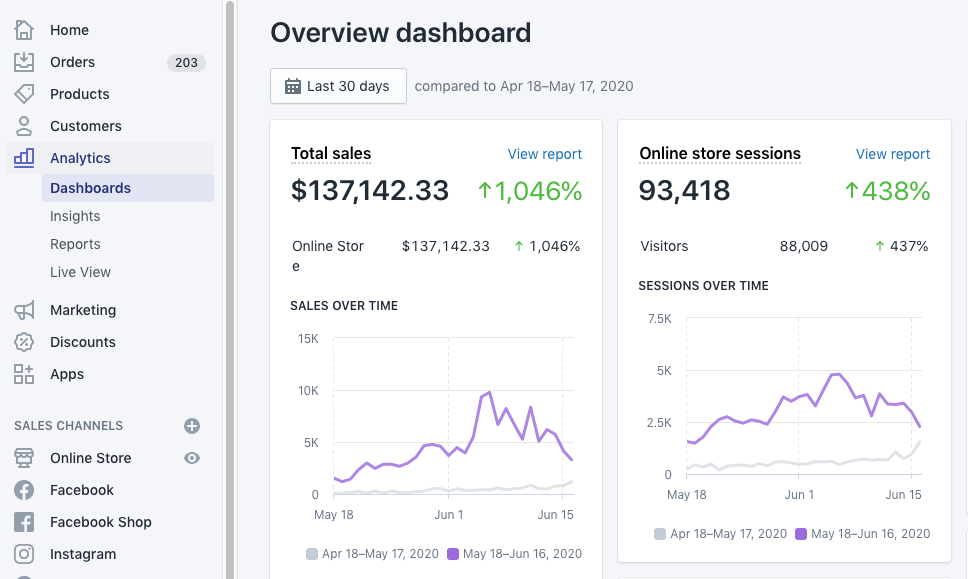
Reporting expands considerably on Grow. You gain professional reports across sales, customers, inventory, behaviour and marketing performance. These are genuinely useful for making data-driven decisions about stock, marketing spend and retention. They are not just prettier versions of the Basic dashboard.
Shopify Flow is one of the most valuable features made available at this tier. It lets you automate repetitive workflows without writing code: tagging high-value customers, sending restocking alerts, flagging suspicious orders, triggering personalised email sequences based on behaviour. A well-configured set of Flow automations regularly saves merchants several hours of manual work per week across the accounts we manage. That time saving alone can justify the plan upgrade.
Staff accounts increase to 5 on Grow, which covers most small teams. Transaction fees drop to 1.7% + 25p online with Shopify Payments. For a store processing £30,000 per month, moving from Basic to Grow saves approximately £90 in transaction fees monthly. That nearly covers the plan upgrade cost of £30/month on its own.
Grow is right for: businesses with a small team needing admin access, merchants who want detailed performance analytics to guide decisions, operations looking to automate manual processes, and stores processing roughly £10,000+ monthly where lower transaction fees start to create meaningful savings.
Shopify Advanced: £259 to £344 per Month
Advanced is built for established businesses with complex needs around reporting, shipping and international operations. At £259 per month annually or £344 monthly, it delivers the most comprehensive feature set before moving to enterprise-level Shopify Plus.
Custom report building is the standout feature here. You can create entirely bespoke reports using Shopify's filtering tools, drilling into specific metrics and combining data in ways the standard reports do not allow. These reports can be saved, scheduled and shared with team members. They are genuinely useful for data-driven operations and marketing teams.
Third-party calculated shipping rates become available on Advanced. Carriers like UPS, FedEx and DHL can calculate real-time rates at checkout based on package dimensions and destination. This is far more accurate than flat-rate estimates and removes the risk of either overcharging customers or subsidising shipping from your margin.
For international sellers, Advanced includes estimated duties and import taxes at checkout. This calculates likely customs charges on international orders, preventing customers from facing unexpected fees on delivery. Across the cross-border stores we run, this feature alone meaningfully reduces cart abandonment on international orders. Customers trust what they can see upfront.
Staff accounts expand to 15, and transaction fees drop to 1.5% + 25p online with Shopify Payments. The third-party gateway fee falls to 0.6%, making Advanced attractive for merchants who must use an external payment provider.
Advanced is right for: larger teams requiring granular access controls, merchants needing custom analytics, international sellers wanting accurate duties calculation, and high-volume stores where lower transaction fees generate meaningful monthly savings.
Shopify Plus: Enterprise Pricing from £1,800 per Month
Shopify Plus is the enterprise tier for high-growth and high-volume merchants. Pricing starts from approximately £1,800 per month, available on either a 1-year or 3-year term, with the majority of merchants on shorter agreements paying between £2,000 and £2,500 depending on transaction volume and negotiated terms. Exact pricing is agreed directly with Shopify.
Plus pricing has two structures depending on your monthly online revenue. Below a defined threshold (typically when 0.25% of monthly sales remains below the £1,800 floor), you pay the flat monthly fee. Above that threshold, Shopify switches you to a variable model where you pay roughly 0.25% of monthly online revenue, capped at an agreed maximum. In practice, the flat fee applies for most merchants moving onto Plus, and the variable structure kicks in once you are doing comfortably north of £700,000 in monthly online sales. The example transition point is rarely a surprise. Shopify models it during the commercial conversation, not after you sign.
The platform difference with Plus is significant. You get a dedicated launch manager, a named Shopify Plus Merchant Success Manager, priority 24/7 phone support, and tooling designed for complex multi-store operations. Plus merchants can create up to 9 expansion stores alongside their main store, enabling genuine localisation across markets, with separate storefronts, separate inventory logic, separate checkouts. Plus also supports up to 200 POS Pro locations for retail-heavy businesses running physical alongside online.
Checkout customisation is exclusive to Plus. Standard Shopify plans offer limited checkout modifications; Plus merchants can edit checkout files directly, adding custom fields, changing layouts, implementing complex shipping logic and building branded checkout experiences. For high-AOV brands, a conversion-optimised checkout often pays back the Plus subscription many times over.
Shopify Scripts allow Plus merchants to write custom logic for advanced discounting: quantity-based pricing tiers, customer-tag-specific prices, dynamic gift-with-purchase offers and complex bundle pricing that standard discount codes cannot achieve. If your commercial model depends on nuanced pricing logic, this feature alone can be a strong reason to move to Plus.
Shopify Launchpad lets you schedule store-wide changes simultaneously: theme swaps, discount activations, product visibility changes. For flash sales, product launches and seasonal campaigns, this removes the risk of coordinating manual changes under pressure.
B2B Commerce on Shopify Plus provides full wholesale functionality: company profiles, custom price lists, payment terms (net-30 etc.), quantity discounts and a dedicated B2B portal. This eliminates the need for separate wholesale systems. Plus also exposes additional APIs and webhooks for custom workflows that enterprise brands need to plug into their own ERP, OMS and finance systems. Learn more about the key differences between Shopify and Shopify Plus.
Transaction fees on Plus are negotiated. Shopify publishes a "from 1.3% + 25p" rate online, with most Plus merchants landing somewhere in the 1.3% to 1.5% band depending on volume and category. At significant GMV, even small improvements to the rate represent thousands of pounds annually.
Shopify Plus is right for: businesses exceeding £1 million annual revenue, brands requiring multiple regional storefronts, merchants needing checkout customisation or advanced discounting, companies with B2B operations alongside DTC, and high-growth brands anticipating significant scaling in the next 12-24 months.

Additional Costs to Consider
The monthly subscription and transaction fees are just the start. Understanding the real cost of running a Shopify store means accounting for apps, themes, domains, email marketing tools and potentially professional services. Merchants who budget only for the subscription are regularly surprised by the total once the full operating cost lands.
Shopify Apps
The Shopify App Store contains over 8,000 apps and plugins covering every category from reviews and loyalty to upsells, shipping discounts and store design tools. Many are free, but premium apps for reviews, loyalty programmes, email marketing, subscriptions and advanced search typically cost £10 to £300+ per month depending on your store's scale. Common app costs include:
- Email marketing (Klaviyo, Omnisend): £0-400 per month based on subscriber count
- Reviews (Yotpo, Judge.me, Reviews.io): £0-150 per month
- Loyalty programmes (LoyaltyLion, Smile): £50-400 per month
- Subscriptions (Recharge, Loop): £50-500 per month based on subscriber count
- Customer support (Gorgias, Zendesk): £50-300 per month
- Search and merchandising (Searchanise, Boost Commerce): £20-200 per month
We typically see merchants spending £150 to £600 monthly on apps across a standard DTC store. Enterprise stores regularly exceed £1,500. Audit your app stack quarterly. Unused apps are a common source of avoidable cost.
One often-missed cost: gift cards and store credit redeemed at checkout can still trigger third-party transaction fees on certain plans, even when Shopify Payments is your primary processor. The exception applies because gift cards count as payment instruments outside Shopify Payments. If gift cards or store credit form a meaningful share of your revenue, factor this nuance into your plan choice.
Themes
Shopify's Theme Store offers free themes and over 100 premium options priced between £180 and £350 as a one-time purchase. Custom theme development from an agency ranges from £10,000 to £100,000+ depending on complexity. Many businesses achieve strong results with a premium theme and thoughtful customisation rather than a full bespoke build.
Domains
A custom domain name purchased through Shopify starts at approximately £11 per year for .com addresses. You can connect an existing domain from any registrar. Shopify includes a free .myshopify.com subdomain, but a proper domain name is essential for professional branding from day one. Payouts from Shopify Payments deposit into your bank account regardless of where the domain is registered, so this is purely a branding decision.
Point of Sale Hardware
If you sell in person, Shopify POS hardware ranges from £49 for a card reader to £229 for a full countertop terminal setup. POS Pro software adds £69 per month per location and adds staff permissions, inventory transfers, detailed retail reports and advanced exchange workflows. Budget for both hardware and software if you run a physical retail presence alongside your online store.
Professional Services
Many brands invest in design, development or ongoing agency support. Shopify agency services range from small project work starting around £1,500 to comprehensive builds and retainer agreements of £3,000 to £10,000+ monthly. Our Shopify Plus services focus on brands ready to scale with expert support. The right agency typically pays for itself through improved conversion rates, reduced technical debt and better platform utilisation.

Which Shopify Plan Should You Choose?
The right plan depends on your current situation and where you are heading. Here is our recommendation framework, based on working with hundreds of Shopify merchants across different stages and sectors:
Choose Starter if: you are a content creator or social seller monetising an existing audience through social channels. Understand that the 5% transaction fee makes it uneconomical for any serious sales volume. At £5,000 per month, you are paying £250 in transaction fees against a £5 subscription.
Choose Basic if: you are launching a new ecommerce business, expect to handle operations personally or with minimal staff, and want to prove your concept before investing in advanced features. Basic provides everything needed to run a legitimate, professional store.
Choose Grow if: you have a small team needing admin access, you want professional reporting to guide decisions, or you are processing enough volume that the lower transaction fees offset the higher subscription. The break-even is typically around £10,000-£15,000 monthly revenue. See our analysis below.
Choose Advanced if: you need custom reporting, sell internationally and want accurate duties calculation at checkout, use third-party carrier-calculated shipping rates, or have a larger team requiring 15 staff accounts. Advanced also makes financial sense for stores doing £80,000-£100,000 or more per month, where the transaction fee difference covers the subscription cost many times over.
Choose Plus if: you are exceeding £1 million in annual revenue, need multiple storefronts, require checkout customisation, have B2B operations, or need enterprise-grade support and account management. The jump to Plus is a significant one, but for the right businesses the ROI from better conversion rates, checkout control and dedicated support makes it straightforward.
Break-Even Analysis: When Does Upgrading Save You Money?
One of the most useful things we do for clients is model the break-even point for plan upgrades. The question is not just "which plan has the features I need". It is "at what revenue level does the lower transaction fee on the next plan save more than the increased subscription costs?"
This calculation is straightforward. The plan upgrade cost is the difference in monthly subscription fee. The saving is the reduction in transaction fee rate multiplied by your monthly revenue.
Basic to Grow (saving 0.3% on transaction fees, cost £30/month on annual billing):
- At £10,000/month revenue: saving = £30. Break-even exactly. Upgrade makes sense.
- At £15,000/month revenue: saving = £45. Net gain of £15/month from upgrading.
- At £30,000/month revenue: saving = £90. Net gain of £60/month from upgrading.
Grow to Advanced (saving 0.2% on transaction fees, cost £210/month on annual billing):
- At £80,000/month revenue: saving = £160. Still slightly below break-even.
- At £105,000/month revenue: saving = £210. Break-even exactly.
- At £150,000/month revenue: saving = £300. Net gain of £90/month from upgrading.
These numbers assume you are using Shopify Payments throughout. If you are using a third-party gateway, the fee differences are larger (2.0%, 1.0%, 0.6%) and the break-even points are significantly lower. A merchant on Basic using PayPal pays an additional 2.0% Shopify fee on top of PayPal's own charges. Switching to Shopify Payments on Advanced eliminates that entirely, which often represents thousands per month in savings for high-volume merchants.
Do not forget to factor in the value of features like Flow automation, professional reporting and staff accounts. If Shopify Flow saves your team two hours per week, and your team's time is worth £25/hour, that is £200/month in recovered productivity, which changes the maths considerably in favour of upgrading to Grow.

How to Save Money on Shopify
Several strategies can reduce your total Shopify costs without compromising on functionality:
Choose annual billing. All plans except Starter offer a 25% discount on annual billing. For the Grow plan, this means paying £588 per year instead of £780, saving £192 annually. On Advanced, annual billing saves £1,020 per year compared to monthly. These are meaningful savings that compound over time.
Use Shopify Payments. Third-party gateway fees of 0.6% to 2.0% add up fast. Unless you have a specific requirement for an external processor, Shopify Payments removes this layer entirely and provides the most competitive combined rate.
Earn and apply Shopify Credits. Each plan earns credits back on Shopify-managed revenue: Basic earns 1% back up to £3,500, Grow earns 1% up to £5,500, and Advanced earns 1% up to £7,000 per billing cycle. These credits apply directly against your Shopify bill, reducing your effective monthly cost. A Grow merchant earning the maximum credit each month effectively reduces their bill by £55, nearly the entire subscription cost. This is an underutilised feature worth tracking.
Take advantage of promotional pricing. Shopify regularly runs deals including the current £1 per month for the first three months on Basic, Grow and Advanced. Starting during a promotional window locks in a lower initial cost while you build revenue.
Audit your app stack quarterly. App costs accumulate silently. Review every installed app every three months, remove anything you are not actively using, and look for consolidation opportunities. A single comprehensive platform (such as Klaviyo handling both email and SMS) often costs less than two separate single-purpose tools with overlapping functionality.
Start with a premium theme rather than a custom build. Investing £200-350 in a well-built premium theme saves thousands compared to custom development at the outset. Most premium themes are highly customisable through the theme editor without writing code. Custom builds make sense when you have proven your model and have specific requirements a theme cannot meet.
Model your upgrade timing carefully. Use the break-even analysis above to time plan upgrades. Upgrading too early costs money unnecessarily; upgrading too late leaves savings on the table. The right time is when the transaction fee savings clearly exceed the subscription difference, typically alongside a genuine need for the features the higher plan opens up.
How Does Shopify Compare to Other Platforms?
Shopify's pricing sits in the mid-range compared to other ecommerce platforms, but direct comparisons are misleading without considering the total cost of ownership: hosting, security, maintenance, developer time and the opportunity cost of downtime or a clunky checkout. Unlike marketplaces such as Amazon or Etsy, Shopify gives you a standalone store where you own the customer relationship, the data and the brand. The commission economics of marketplaces look cheap on the surface but cost you optionality longer term.
Wix and Squarespace (£15-35 per month) appear cheaper on paper, but both lack Shopify's ecommerce depth. Transaction fees are often higher, app ecosystems smaller, and enterprise scalability non-existent. For a business that is genuinely focused on ecommerce as a primary channel, Shopify offers considerably better value despite the higher subscription.
A UK-specific consideration worth flagging: VAT registration is mandatory once turnover exceeds £85,000 per year, regardless of which platform you use. Shopify does not collect or charge VAT on its own subscription fees, but you remain responsible for charging customers and remitting VAT once you cross the threshold. This is identical on Wix or Squarespace. The platform choice does not change your VAT obligations.
BigCommerce (£22-240 per month) is Shopify's closest direct competitor. Pricing is comparable and both platforms offer strong ecommerce features. Shopify generally leads on app ecosystem breadth, theme availability and merchant adoption. BigCommerce includes more built-in features at lower tiers, which can reduce app dependency. That said, Shopify's ecosystem advantage, across integrations, agency expertise and ongoing platform investment, is substantial. For comparison options, also see our articles on Shopify vs Amazon and Shopify vs Etsy.
WooCommerce is technically free as a WordPress plugin, but requires separate managed hosting (£15-100+ monthly), SSL certificates, payment gateway setup, ongoing plugin maintenance and security patching. Total cost frequently exceeds Shopify while requiring considerably more technical overhead. The "free" platform is often more expensive in practice once developer time is factored in.
Magento / Adobe Commerce targets enterprise merchants with licensing starting around £20,000 annually plus substantial hosting and development costs. Shopify Plus offers comparable or superior enterprise capabilities, particularly in checkout customisation and B2B, at a fraction of the total investment. The migration economics from Magento to Shopify Plus are compelling for most merchants.
For most growing ecommerce businesses, Shopify provides the best balance of features, reliability, scalability and total cost. The platform handles hosting, security and updates, so your team focuses on products, marketing and customers rather than infrastructure. If you are looking to grow your Shopify store's organic visibility, our Shopify SEO guide is a good next step.
Where We'd Actually Point a Brand on the Pricing Ladder
After more than 100 Shopify and Shopify Plus builds since 2018, the pattern we see most consistently is brands overpaying for plans they have outgrown features-wise, while underpaying attention to transaction fees until cumulative card-fee waste already exceeds the plan-cost difference they were trying to save by staying low.
The single piece of advice we give clients on this question: at £15,000 monthly online revenue, we would rather see you on Grow than on Basic with "we will upgrade when it makes sense" as the plan. By that point, the transaction-fee delta between the two tiers has already paid for the upgrade twice over, and you have a year of better reporting and Flow automation you cannot recover. The same logic applies higher up the ladder. Most of the businesses we move from Advanced to Plus are not making the move for the brand-fit or feature-set reasons Shopify markets on. They are doing it because £400,000 monthly online revenue at 0.2% saved on card rates is £800 a month, and the structure of Plus simply costs less than staying.
Pricing decisions on Shopify are rarely about the headline plan number. For business owners, they are about how the transaction fee, app stack and operational time costs compound against your monthly volume across the countries you sell into. If you want a sanity check on which tier actually makes commercial sense for your trajectory, that is the conversation our Shopify Plus team has every week, and the right answer often surfaces a few good questions about where the business is heading rather than where it is today.