 Nic Dunn, CEO, Charle Agency
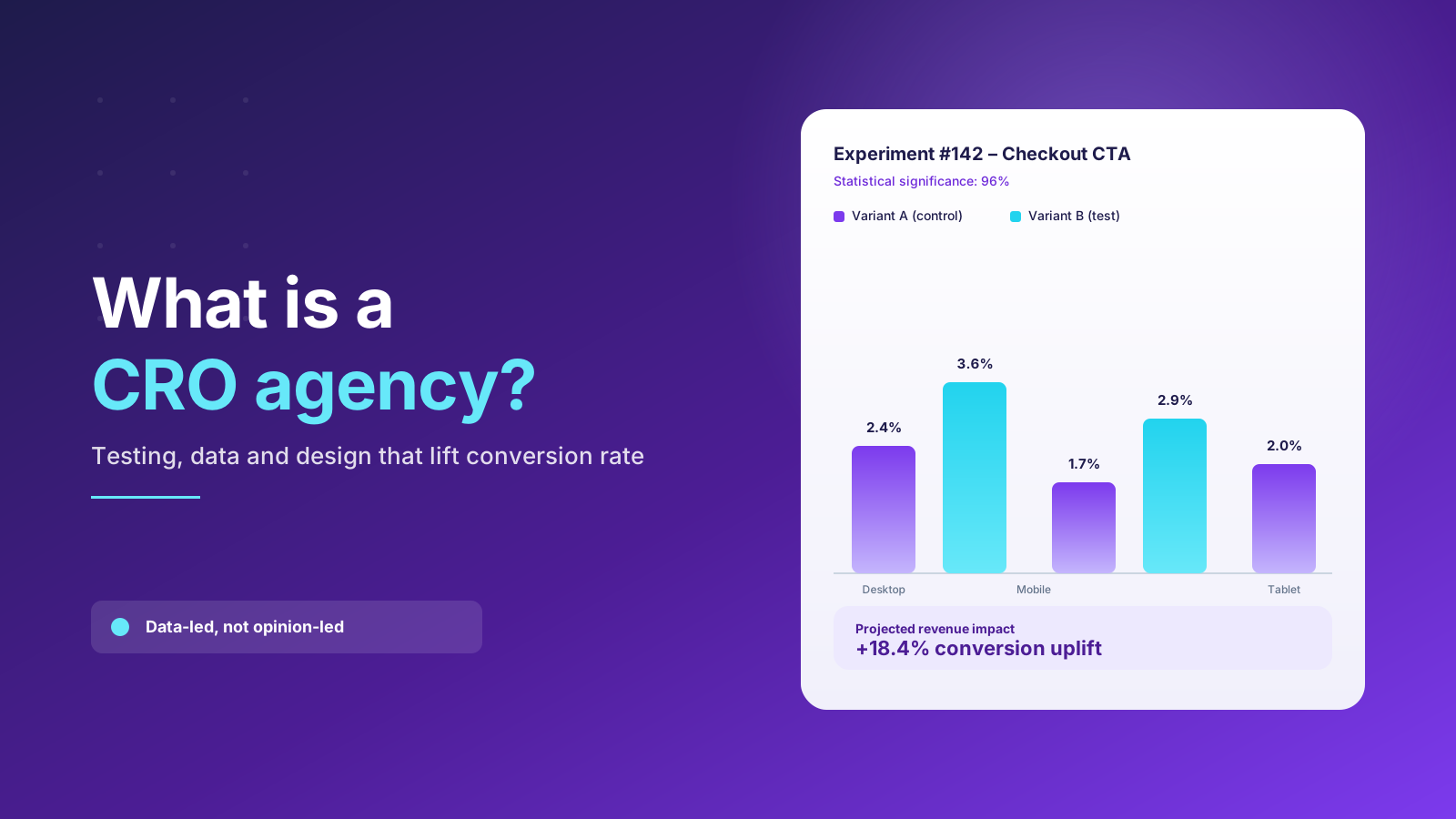
Definition of a CRO Agency
A CRO agency, short for conversion rate optimisation agency, is a dedicated team whose main goal is improving the percentage of visitors who complete a desired action on your site. That action might be placing an order on an ecommerce store, signing up for a newsletter, starting a free trial or submitting a contact form. Rather than chasing more traffic, a CRO agency focuses on turning more of that existing traffic into conversions.
The core method is structured experimentation. A CRO agency gathers data on how visitors actually behave, using analytics, heatmaps and session recordings, then forms a hypothesis about what's causing friction. That hypothesis gets tested through A/B or multivariate testing rather than shipped on instinct. Only changes that prove a genuine uplift in conversion rate get rolled out permanently.
The commercial logic is straightforward. If you're spending a meaningful budget driving traffic to your website, a higher conversion rate means every pound of that spend works harder. A CRO agency typically works iteratively as part of a wider strategy, testing small changes and measuring the impact, so conversion rate and related metrics improve steadily rather than in one large, risky redesign. The results of each test then feed directly into the next round of hypotheses.
The Role and Responsibilities of a CRO Agency
The role of a CRO agency is not to bring in more visitors. That's the job of SEO and paid media. Instead, a CRO agency increases the efficiency of your existing traffic by turning more of those visitors into customers. For a broader look at how CRO fits alongside organic growth, see our ecommerce SEO agency page.
Most CRO agencies start by reviewing your website's data to understand user behaviour. Analytics platforms, heatmapping tools and session recordings are used together to build a picture of how users actually move through your site and where they hesitate or leave. Alongside this, the agency maps the conversion funnel end to end, from landing page to checkout, to identify the steps worth prioritising first.
Customer behaviour shifts from week to week and season to season, so testing needs a fair, like-for-like comparison rather than a before-and-after guess. That's why split A/B testing sits at the centre of a serious CRO agency's approach. It's the only reliable way to separate a genuine improvement from a seasonal blip or a change in traffic mix.
Delivery usually involves in-house UI and UX designers and developers who build the improvements the roadmap calls for. That might mean redesigning navigation for a more intuitive journey, rebuilding a high-traffic landing page, or rolling out new messaging and layout variants for testing. Technical work such as site speed, mobile responsiveness and accessibility fixes often sits alongside the UX changes, because a slow or broken experience undermines every other optimisation.
Finally, a CRO agency has an ongoing responsibility to monitor, report and learn from every test's results, whether it wins or loses. That historical record of experiments becomes an asset in its own right for clients, informing the next round of hypotheses and preventing the same failed idea from being retested twice.

Services a CRO Agency Offers
The exact service list varies by agency, but most CRO agencies deliver a similar core package built around research, testing, design and reporting.
It typically starts with a data, funnel and website audit that identifies friction points and opportunities using both quantitative methods (analytics, KPI tracking) and qualitative methods (surveys, polls, user interviews). The output is a prioritised roadmap of tasks rather than a vague list of suggestions.
That roadmap is then delivered by a mix of specialists. Designers handle UX and UI changes such as landing page layout, cart and checkout redesigns, and new call-to-action treatments. Developers build and QA those changes, and often handle technical performance work like page speed and mobile fixes at the same time.
Copywriting and messaging optimisation is another common service, covering headlines, product descriptions and CTAs written specifically to support the conversion goal being tested. Personalisation and dynamic content sit alongside this, tailoring specific experiences to different audience segments to lift conversion rates further.
Every serious CRO agency will offer split A/B testing as the mechanism for validating all of the above, using statistical models to confirm a result before it's rolled out. Agencies typically deliver this as either a one-off audit with a roadmap for your team to execute, or, more commonly, an ongoing CRO retainer that runs continuous testing month after month.

Benefits of Working With a CRO Agency
A skilled CRO agency can move both the revenue and the overall performance of your traffic, not just a headline conversion rate number, and the extra conversions tend to compound across every channel.
Increased revenue without increasing traffic. The clearest benefit is that a higher conversion rate produces more revenue from the traffic you're already paying to acquire. That also improves the effective return on every other marketing channel, since your paid media, SEO and email all convert at a higher rate once the on-site experience improves.
Removes guesswork. Changing a website based on internal opinion is a common way to accidentally reduce conversion rate. A CRO agency relies on analytics, A/B testing and user behaviour data, and waits for statistical significance before calling a result, so decisions are backed by evidence rather than the loudest voice in the room.
Better user experience. The work a CRO agency does to reduce friction usually improves the wider experience too. A site that's clearer, faster and more trustworthy tends to see better engagement, more repeat visits and stronger brand perception alongside the conversion rate uplift.
Clearer ROI on marketing spend. CRO improves the efficiency of every channel at once rather than one in isolation, so a conversion rate improvement made this quarter keeps paying back on every subsequent visitor.
Tools and Technology CRO Agencies Use
A CRO agency needs a specific toolkit to analyse visitor behaviour, run split tests and track performance over time.
Reporting and analytics. Website analytics platforms track pages per visit, time on site, bounce rate and engagement, giving the agency the raw material for hypotheses. Google Analytics 4 remains the most common baseline, often supplemented with dedicated ecommerce reporting tools.
A/B testing and experimentation. Tools such as Shoplift for Shopify, Optimizely and VWO let an agency show different variants to a split of your audience, then confirm once a test reaches statistical significance and can be trusted to represent your wider customer base.
Heatmaps and session recordings. Understanding how customers behave in the moment is essential to spotting friction. Hotjar, Microsoft Clarity and Crazy Egg are widely used to visualise scroll depth, clicks and rage clicks, the repeated, frustrated clicks that flag a broken or confusing element.
Personalisation and behavioural targeting. Tools like Nosto and Dynamic Yield let an agency serve different content to different visitor segments, which can meaningfully lift conversion rates for returning customers versus new ones.
Site speed and performance. Improving site speed reduces drop-off caused by frustration, and Google's Core Web Vitals, PageSpeed Insights and GTmetrix are the standard tools for measuring it.

CRO in Action: What a Good Programme Looks Like
A well-run CRO programme looks less like a single big redesign and more like a steady rhythm: audit, hypothesis, test, learn, repeat. On a typical Shopify store, an early cycle might target the highest-traffic landing page or the cart-to-checkout step, since that's usually where the largest single drop-off in the funnel sits.
As a Shopify accredited agency, Charle delivers CRO through our membership offering, pairing Shopify web design and development with ongoing testing so the design, build and experimentation stay joined up rather than handled by separate, disconnected teams. That combination matters because a winning test still needs to be built properly and monitored afterwards, not just declared a win and forgotten. Our clients typically see this strategy play out as a rolling roadmap rather than a single project. You can see examples of the design and development work behind our CRO programmes in our case studies.
Whatever the size of your business, the same principle holds: a CRO agency's value comes from compounding small, tested improvements over time, backed by clarity on which changes actually moved the numbers and which didn't.
How to Choose the Right CRO Agency for Your Business
Choosing a CRO agency starts with clarity on your own goals. Decide what you actually want to move, whether that's conversion rate, average order value or lead quality, and check the agency you're considering understands and accepts that target before you sign anything.
Review their track record with genuine scrutiny. Ask for real case studies and results from clients relevant to your industry and traffic volume, not just logos on a homepage. A strong CRO agency should be comfortable walking you through a specific test, including ones that didn't work, since honest reporting on losing tests is a good signal of a data-driven culture rather than a sales-driven one.
Understand their approach and tech stack, and check whether you're expected to fund any of the tooling separately. Agencies vary in whether testing software, analytics platforms and heatmap tools are included in the retainer or billed on top.
Finally, align on realistic timelines. Meaningful, statistically significant results typically take weeks rather than days, especially on lower-traffic pages, so be wary of any CRO agency promising overnight transformation. If you're weighing a Shopify-specific partner more broadly, our roundup of top Shopify agencies covers the wider selection criteria too.

Measuring CRO Success: The KPIs That Matter
Measuring CRO success starts with conversion rate, but it shouldn't stop there. Compare conversion rate within a controlled A/B test rather than month over month, because seasonality, marketing mix and macroeconomic factors all move conversion rates independently of any test you're running.
Beyond the headline number, agencies typically track average order value, bounce rate, cart and checkout abandonment, scroll depth, and cost-per-acquisition by channel. Which of these matter most depends on the specific test and audience, but the comparison should always be test result versus control, not this month versus last month.
Return on investment is the metric that ultimately justifies the retainer. A CRO agency should be able to show the projected or actual revenue impact of a winning test's results against the cost of running the programme, so businesses can judge whether the engagement is paying for itself well beyond the testing budget alone.
Charle's View: Is a CRO Agency Worth It in 2026?
Charle is primarily a Shopify design and development agency, and CRO sits inside that work rather than as a bolt-on service, which shapes our view here. A dedicated CRO agency earns its retainer when the fundamentals are already sound: the site loads quickly, the value proposition is clear, and there's enough traffic to reach statistical significance in a reasonable timeframe. Testing button colours on a page with weak positioning or broken checkout logic rarely moves the needle, no matter how rigorous the experimentation.
Where CRO earns its keep is when design, development and testing are handled together. A test that proves a new product page layout converts better is only useful if it can be built properly and shipped without breaking something else on the theme. That's the practical argument for pairing CRO with a Shopify development partner rather than running it in isolation from the rest of the store.
Conclusion
A CRO agency exists to help you get more from the traffic you already have, using data, hypothesis-driven testing and design and development delivered together rather than as separate workstreams. Whether you're running an ecommerce store, a SaaS platform or a lead generation site, the underlying method is the same: identify friction, test a fix, measure the result, and repeat.
The businesses that get the most from a CRO agency treat it as an ongoing programme rather than a one-off project, reviewing conversion rates, average order value and ROI on a regular cycle and feeding those learnings back into the next round of tests.
If you're looking to get more from your existing Shopify traffic, our team can support your next phase of growth with combined design, development and conversion rate optimisation. Get in touch to talk through where your funnel is leaking and what a testing roadmap could look like for your store.