 Nic Dunn, CEO, Charle Agency
What Is Agentic Commerce?
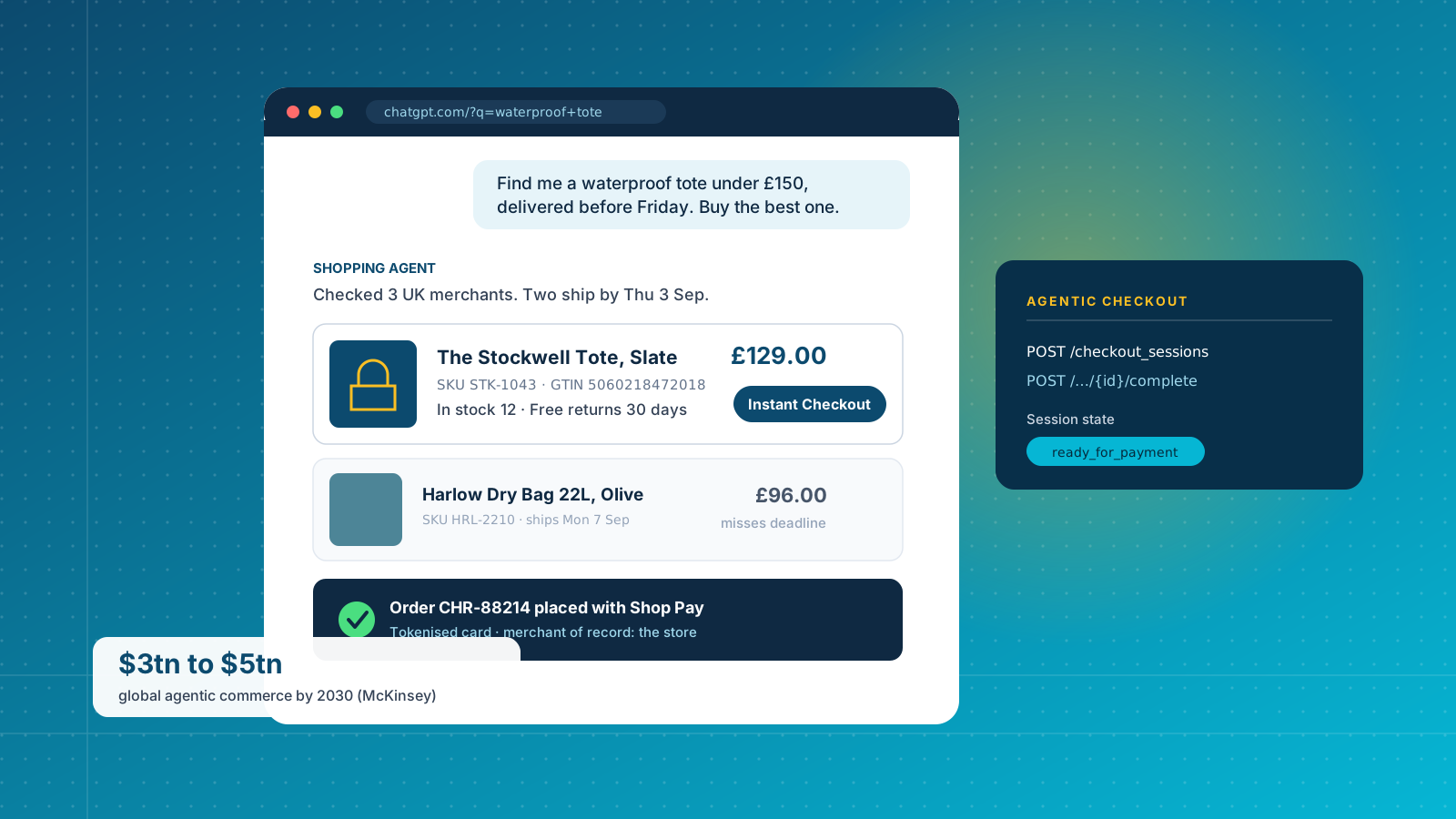
Agentic commerce is shopping in which autonomous AI agents handle the transactional work on a buyer's behalf: searching, comparing prices, checking stock and return policies, and completing the purchase inside defined constraints. The user sets the goal and the budget. The agent does the rest and reports back. That is the whole idea, and everything else in this agentic commerce guide is a consequence of it.
The difference between a chatbot and an agentic shopping assistant is significant. When you ask ChatGPT for product recommendations, it provides information. When you ask an agent to buy you running shoes under £100 that match your gait type and preferred brands, it searches multiple retailers, compares options, checks your loyalty rewards, applies the best available discount and completes checkout. That entire journey happens autonomously, and the merchant on the other end never speaks to a person.
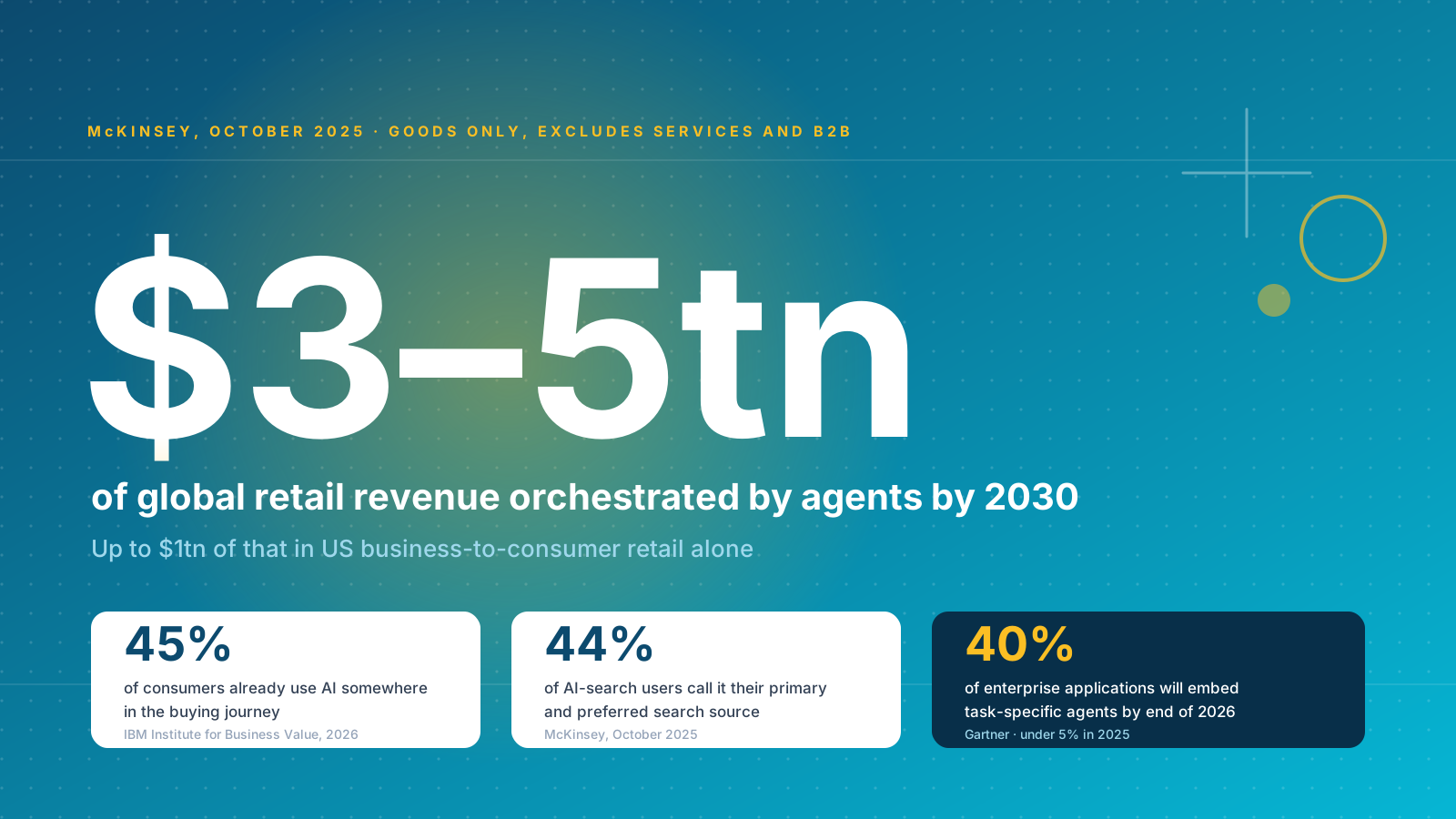
Adoption is further along than most brands assume. IBM's Institute for Business Value found in 2026 that 45% of consumers already use AI at some point in the buying journey. McKinsey reports that 44% of people who search with AI now call it their primary and preferred search source. Gartner expects 40% of enterprise applications to embed task-specific AI agents by the end of 2026, up from under 5% in 2025, and those two trends feed each other: the more businesses ship agents, the more digital buying moves through them.
The money follows the behaviour. McKinsey puts up to $1 trillion of US business-to-consumer retail revenue as agent-orchestrated by 2030, with a global range of $3 trillion to $5 trillion for goods alone. Those are forecasts, not results, and they exclude services and B2B procurement entirely.
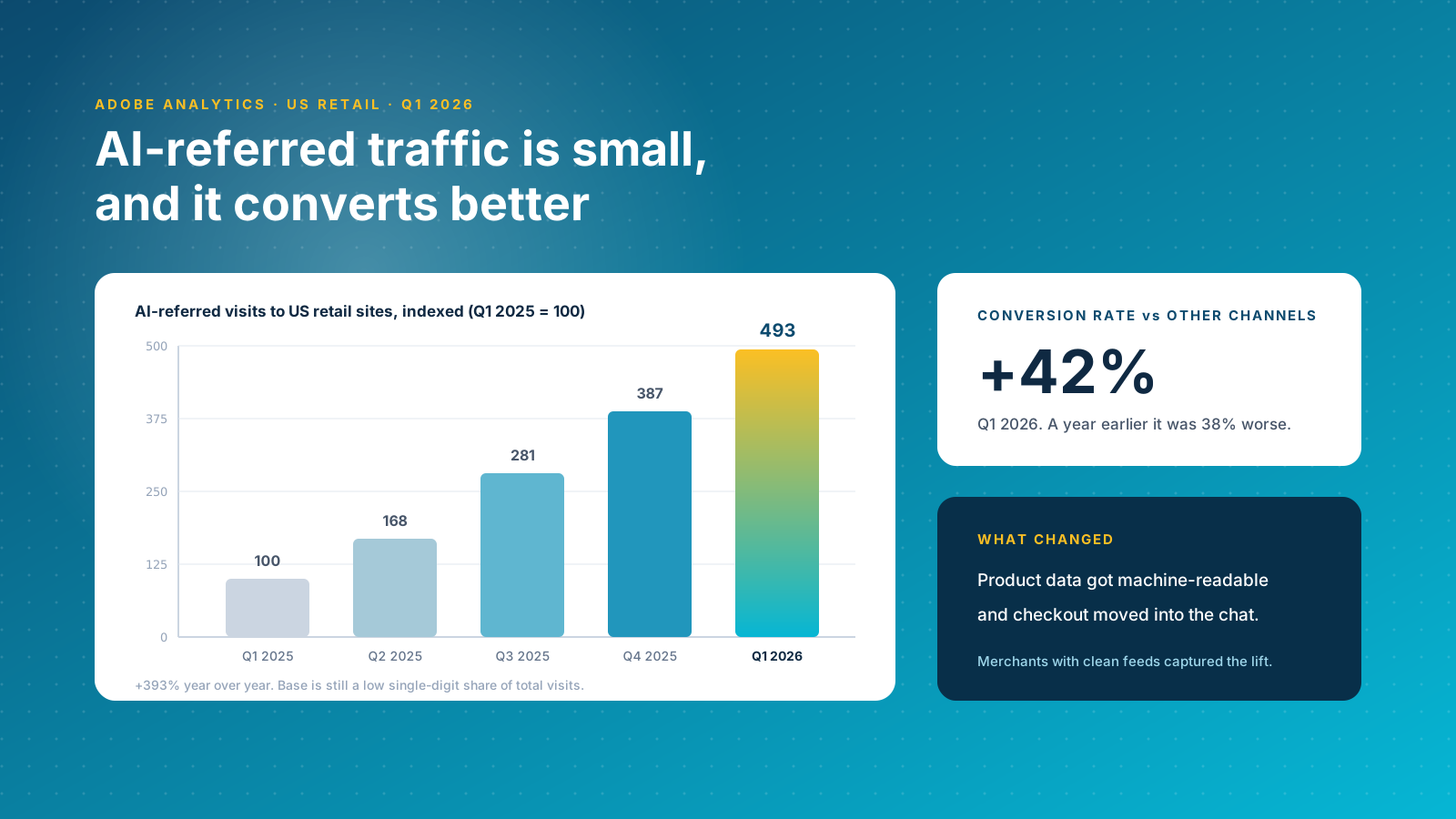
What is not a forecast is the traffic. Adobe Analytics recorded AI-referred visits to US retail sites up 393% year over year in the first quarter of 2026, converting roughly 42% better than other channels. A year earlier the same traffic converted about 38% worse. The infrastructure got built, the product data got cleaner, and the numbers turned.
How Agentic Commerce Works
To understand agentic commerce, you need to understand both how AI agents function and how they interact with merchants and payment systems.
The Three Components of a Shopping Agent
Every effective shopping agent relies on three capabilities. Memory retains preferences, sizes, past purchases and brand affinities across sessions. Reasoning breaks a complex request into structured steps, so agents work out what you actually need and how to weigh price against quality. Tools give agents the ability to act: through APIs and integrations with ecommerce platforms, AI agents search a product catalogue, check inventory, apply discount codes and complete checkout. Without tool access, an agent is a sophisticated recommendation engine and nothing more.
Autonomy is not all-or-nothing. Serious agentic commerce implementations tier it: low-value repeat purchases run unattended through automation, while any expensive or sensitive purchase still stops for human approval.
The Three Interaction Models
Agentic commerce operates through three primary interaction models.
Agent to site describes agents transacting directly with merchant platforms: visiting a retailer's site, searching the catalogue, adding items to a cart and completing checkout. It works best where retailers have structured data and robust APIs.
Agent to agent is autonomous communication between AI systems, where a shopping agent negotiates with a retailer's commerce agent for a bundle discount or a delivery window, in milliseconds.
Brokered agent to site uses an intermediary to coordinate across multiple platforms and agents at once, which is how travel, ticketing and grocery baskets will assemble.
As these models mature, the traditional funnel of search, browse, compare and buy collapses into one intent-driven interaction, and the digital shelf your brand sits on becomes a data feed rather than a page.
The Protocols Powering Agentic Commerce
For agentic commerce to scale, AI agents need a common language to talk to merchants and payment providers. This is where most coverage of the topic stops one level too early. The detail below is what a developer actually has to implement.
Universal Commerce Protocol (UCP)
The Universal Commerce Protocol, co-developed by Google and Shopify and launched at NRF 2026, establishes an open standard for AI agents to connect and transact with any merchant. UCP covers the entire shopping journey, from discovery and checkout to post-purchase support and returns.
What makes UCP significant is its industry backing. Walmart, Target, Etsy, Wayfair, Mastercard, Visa, Stripe, PayPal, American Express and more than 20 other retailers and payment platforms have endorsed it, so this is an industry-wide standard rather than one company's proprietary system.
UCP is built in layers, similar to how TCP/IP underpins the internet. The shopping service defines core transactional primitives like checkout sessions and line items. Capabilities add functional areas such as checkout, orders and catalogue management. Extensions cover subscriptions, pre-orders and custom delivery windows.
For Shopify merchants, UCP is available through Agentic Storefronts, managed directly from the Shopify Admin. Brands can sell through Google AI Mode, the Gemini app and Microsoft Copilot without building a custom integration for each platform.
Agentic Commerce Protocol (ACP)
OpenAI's Agentic Commerce Protocol, developed with Stripe and published under Apache 2.0, powers shopping inside ChatGPT. It is deliberately narrow. ACP standardises two things: conducting a checkout, and relaying payment credentials safely.
On the seller side, ACP is five REST endpoints. You create a checkout session, retrieve it, update it, complete it and cancel it. Every response returns the full authoritative cart state, so the agent never has to infer anything from a rendered page. The seller calculates all prices, taxes, shipping and discounts, manages stock and processes the payment. A session moves through five states, and a failed payment falls back to ready_for_payment rather than cancelling the order outright.
Two details matter commercially. Since spec version 2026-01-30, sellers must declare their capabilities and payment handlers in every response, which replaced the old single payment provider field. And the seller stays the merchant of record throughout. You keep your commerce backend, your payment provider, your pricing, and the right to decline a transaction per agent, per order, or on whatever logic you choose.
Agent Payments Protocol (AP2)
Google's Agent Payments Protocol addresses secure, verifiable payments in agent-led transactions. AP2 uses cryptographically signed mandates that link intent, cart and payment across users, merchants and payment networks, creating an audit trail that makes each transaction traceable.
Mastercard, PayPal, American Express, Adobe and Alibaba have backed AP2. The same principle runs through ACP's Delegate Payment specification, which issues a tokenised credential constrained by amount, currency, expiry and merchant. Raw card details never reach the agent, which is the single most important design decision in the whole stack.
Model Context Protocol (MCP) and Agent-to-Agent Protocol (A2A)
Anthropic's Model Context Protocol lets AI agents share context, intent and data across different models and tools. Unlike static prompts, MCP allows persistent, structured communication, so agents retain memory and objectives across environments.
Google's Agent-to-Agent Protocol lets autonomous agents coordinate, negotiate and complete tasks with one another. A2A supports long-running tasks, dynamic capability discovery and multimodal collaboration, which is the foundation for multi-agent systems.
These protocols stack. A shopping agent might use MCP to hold context about your preferences, A2A to negotiate with a retailer's agent, AP2 to authorise payment and UCP or ACP to complete the checkout.
Where the Hype Outruns the Reality
The protocol documentation is more honest than the marketing built on it. ACP's own developer docs state plainly that implementing the specification does not list your products anywhere, that each AI platform runs its own onboarding, and that the discovery tooling agents need to find compliant merchants is still in progress. To sell inside ChatGPT you apply, and you wait. That gap between protocol innovation and working distribution is where most of 2026 will be spent.
Merchants reporting real numbers describe something narrower than full autonomy. Agent-assisted buying works today in structured, high-intent lanes: specification comparison, bundle building, repeat purchases and B2B procurement. It works badly for fashion, gifting and anything where taste or trust dominates. Treat this as a distribution shift rather than a handover of decision-making. People are still choosing. They are choosing from a shortlist an agent produced.

What Shopify Merchants Actually Have to Do
Almost every agentic commerce guide is written by a payments company, a consultancy or an enterprise platform, and almost none says what a merchant on a real platform should do on Monday morning. Here is the Shopify strategy.
You are further ahead than you think. Shopify connected its merchants to ChatGPT through ACP and co-authored UCP with Google, so the endpoints, session states and tokenised payment handling described above are implemented at platform level. Merchants appearing in AI shopping results today are disproportionately Shopify stores for exactly this reason, which is a real advantage over businesses still writing a roadmap. You are not building a protocol. You are turning one on and feeding it good data.
Enable the digital platforms, one at a time. Agentic Storefronts is managed from the Shopify Admin and covers the Google and Microsoft platforms. ChatGPT is a separate application through OpenAI's merchant programme. Neither is automatic, and neither is instant.
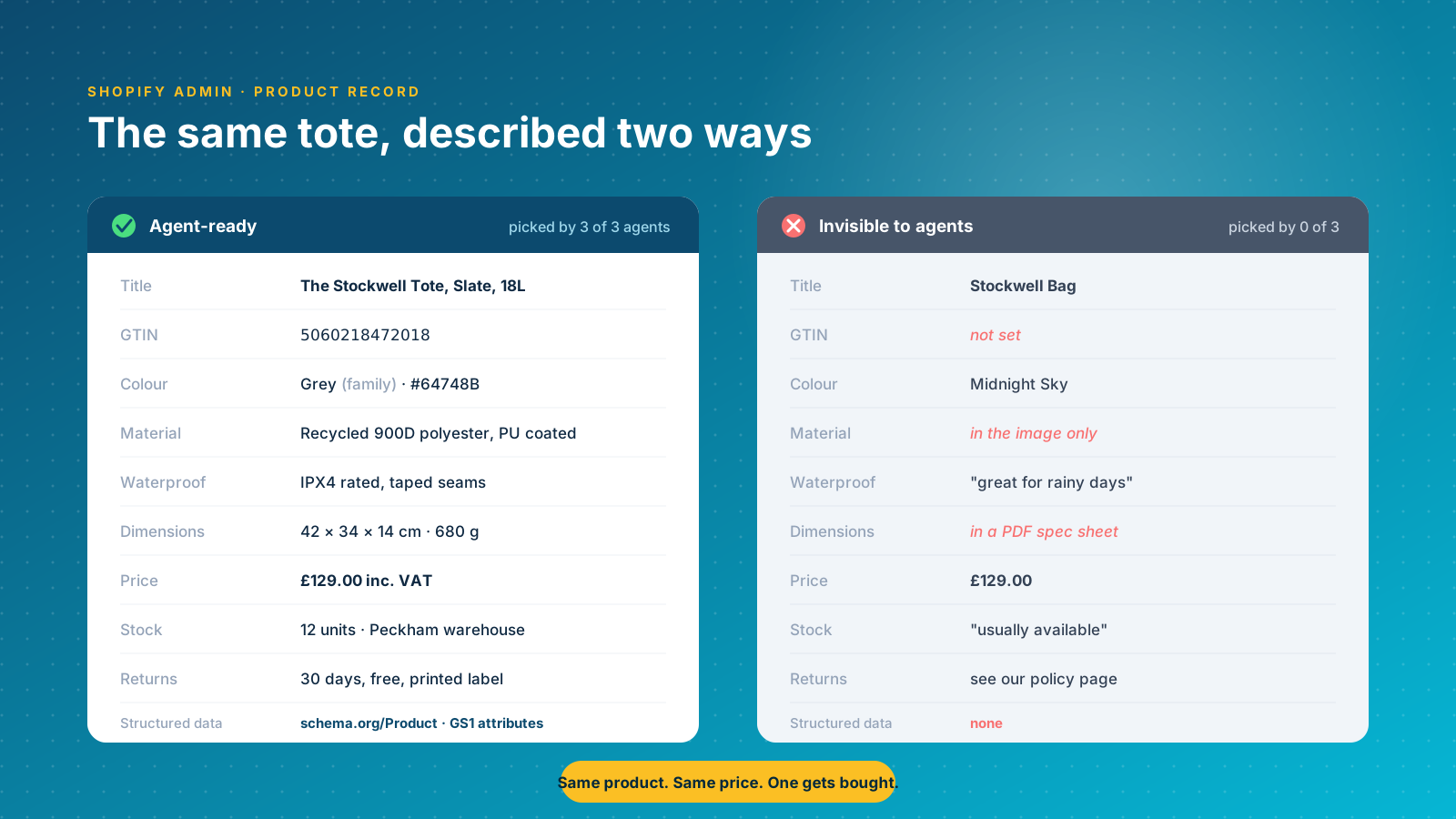
Fix the product catalogue before you fix anything else. Every variant needs a valid GTIN. Colour needs a standard family, not "Midnight Sky". Materials, dimensions, care instructions and compatibility need to sit in metafields as structured data, not in an image or a PDF. Agents cannot read your lifestyle photography.
Make stock and prices honest in real time. AI agents check availability at the moment of purchase. Products that say "usually available" are the products agents skip in favour of one that says twelve units.
Publish your returns policy as data. Return window, who pays postage, and condition requirements are three of the strongest filters agents apply. Burying them on a policy page is the same as not having them.
Decide your rules before an agent tests them. Which agents you accept, whether you honour discount stacking for automated buyers, and what happens on a disputed order are policy questions, not developer questions. Answer them before the transactional volume arrives, not after.
Why Agentic Commerce Matters for Ecommerce Brands
The commercial implications extend beyond a new sales channel. This is a restructuring of how products get discovered, how buying decisions get made and how customer relationships survive automation.
The Discovery Shift
When consumers use AI for product discovery, they bypass traditional search engines, social media and marketplace search bars. Adobe's 393% year-over-year rise in AI-referred retail traffic is the visible edge of that behaviour. For example, a brand ranking well in classic e-commerce search can still be absent from every agent shortlist in its category.
This changes what visibility means. Traditional SEO optimises for keywords and metadata. Generative Engine Optimisation, or GEO, optimises for solutions. The question is not whether your product appears for a search term, but whether an agent recommends it when asked to solve a problem.
Salesforce research puts over half of Gen Z on AI tools for product discovery already.
The Conversion Opportunity
Agent-referred traffic now converts around 42% better than other digital channels, because agents pre-qualify against detailed context before products are surfaced, so the purchases that arrive are unusually well matched on relevance, price and delivery.
The lift is not evenly distributed. It goes to merchants whose data, stock and checkout answer a machine cleanly and instantly. Everyone else loses the buyer at the moment of transaction and never sees the attempt in their analytics.
The Relationship Challenge
In an agentic world your customer may not be a human with a browser. The risk is disintermediation: if AI agents optimise purely for price and specifications, brand differentiation gets harder, because an agent comparing running shoes does not care about your brand story. Personalisation stops being a marketing layer and becomes a data one.
How to Prepare Your Ecommerce Store for Agentic Commerce
With the product catalogue handled, two pieces of preparation remain.
Optimise for AI Discovery (GEO)
Generative Engine Optimisation is emerging as a discipline alongside traditional SEO, and the goal is appearing in AI-generated responses rather than ranking a page. That means anticipating questions rather than keywords. Instead of targeting "waterproof jacket", cover the reasoning agents perform: which materials provide waterproofing, what matters for hiking versus commuting, and the trade-off between breathability and water resistance. Reviews and ratings help too, because an agent weighing two similar products reaches for whatever evidence is machine-readable. Buried in a PDF, none of it exists.
Ensure API and Payment Readiness
Agents need programmatic access to inventory, pricing, checkout and fulfilment, plus delegated authority to spend within limits. Shopify handles almost all of this for you. Custom builds do not get that luxury, and developers face real work on API design, capability declaration and maintenance against a specification that keeps moving. Either way the principle is transparency: every agent action logged and explainable, and the buyer able to see what their agent did, why, and how to reverse it.
How to Measure Agent Traffic
Nobody in this category writes about measurement, which is odd, because it is the only way to tell whether the work paid off. Three things are worth instrumenting, and the analytics insights they produce cost almost nothing to collect.
Referral traffic from AI surfaces. In GA4, segment referrals from chatgpt.com, perplexity.ai, gemini.google.com and copilot.microsoft.com, then compare conversion rate and average order value against organic and paid search. Most businesses find low volume and unusually high intent.
Orders that originated in an agent. Agentic Storefronts and ChatGPT orders arrive tagged in Shopify. Segment them, because their returns behaviour, basket composition and repeat rate differ from your storefront average and will skew blended numbers if left mixed in.
Crawler and agent hits. Server logs show which AI systems fetch your product pages and feeds, how often, and whether they get a 200. A retailer whose catalogue times out for an agent crawler never appears in a recommendation, and no standard analytics dashboard surfaces that.
Set a baseline now. In twelve months the interesting question is not how large agent revenue got, but whether your share of it grew faster than the channel did.
Trust, Security and the Customer Relationship
Trust is the foundation of agentic commerce. When customers delegate purchasing authority to agents, they need confidence that those agents act in their interests, that merchants honour transactions, and that the system is secure.
Know Your Agent (KYA)
Just as financial services require Know Your Customer verification, agentic commerce requires Know Your Agent processes, so merchants can separate legitimate shopping agents from bots attempting fraud or data scraping. Trulioo and HUMAN are building agent verification, and Prove Identity has launched Verified Agent, linking digital identity, intent and payment credentials.
Fraud Prevention
Malicious agents might exploit pricing errors, abuse promotional codes or attempt unauthorised transactions. Criminals can also target the agent itself, feeding misleading offers designed to win an automated comparison. Traditional detection, built around human behavioural patterns, recognises neither, which is why identity-based models are giving way to intent-based ones.
Who Is Liable When an Agent Gets It Wrong
This is the question the payment networks raise and rarely answer. In practice, in 2026, the merchant carries most of it: a card scheme chargeback follows the cardholder, not the software that acted for them, so an agent buying the wrong size produces an ordinary consumer dispute you resolve. The protection is evidence. Keep the signed mandate or session record, log which agent transacted and under what declared constraints, and write an agent-order clause into your returns policy before you need one.
What UK and EU Merchants Have to Handle
None of the major guides to this subject is written for a UK business, and three things differ here. VAT is inclusive in displayed prices, so an agent comparing a UK listing against a US one is comparing different things unless your feed is explicit. Under UK consumer contracts regulations, distance-selling cancellation rights apply to an agent-placed order exactly as to a human one, with the 14-day clock starting on delivery. And the EU AI Act pushes transparency obligations onto automated systems that interact with consumers, which will reach the agent-facing surfaces you expose.
Maintaining the Human Connection
Some transactions demand a person, and UCP models this through checkout states: when an order needs human input, the protocol specifies what is required and how to collect it. A furniture retailer that needs the customer to pick a delivery window communicates that to any agent, and the agents that receive it surface the question rather than abandon the order.
What Comes Next: The Future of Agentic Commerce
The protocols shipping in 2026 are a starting point. Two developments matter more than the rest.
Multi-Agent Systems
Today's agents mostly work alone. Tomorrow's collaborate, with a personal shopping agent coordinating with inventory, delivery and customer service agents to orchestrate one order. This is where the innovation is heading: the interesting products are orchestration layers, not single assistants.
B2B Expansion
Business-to-business procurement is the strongest near-term use case and the least discussed. Reordering a known product at the best available price is exactly the structured, repeatable task agents already do well, and the trust barrier is lower because a buyer reordering components monthly is not making an aesthetic judgement. B2B businesses face the same data quality and API requirements, plus contract pricing and approval workflows.
Beyond those two, expect specialist agents by vertical and channel-based marketing to erode. Both trends point the same way: efficiency accrues to whoever supplies the cleanest data.
What We'd Do First If This Were Your Store, and What We'd Ignore
Our view is that agentic commerce is currently a product data problem wearing an AI costume, and the brands that treat it that way will win the channel cheaply.
If a Shopify Plus client asked us where to start, we would not start with the protocols. We would start with a product data audit: GTINs on every variant, colour families and materials in metafields rather than in copy, dimensions and weights populated, real-time stock, and a returns policy expressed as structured fields. That costs a fraction of an integration project, improves Google Shopping and on-site search at the same time, and is the precondition for every agent surface that exists or is coming.
What we would ignore, for now, is building anything bespoke. Shopify has implemented both protocols. Paying developers to hand-roll an ACP integration on a platform that already ships one is spending money to arrive at the same place later. The same goes for agent-specific pricing and negotiation logic: interesting, unproven, and premature while agent-attributed revenue is still measured in single digits.
The one place we would spend beyond data is measurement, because it is cheap and almost nobody does it. If this channel becomes as significant as the forecasts suggest, brands with twelve months of baseline data will make better decisions than the ones starting from zero.
If you are thinking about how agentic commerce affects your ecommerce SEO strategy, or how our search and AI visibility work applies to AI surfaces, we would welcome the conversation.